My Frugal Adventures is a great blog. You can like "My Frugal Adventures" on Facebook and have all the deals that are posted here show up on your Facebook Home Page.
This is where I found the deal on my Kindle and where I found out about the limited offer of the free Christian Novel called The Pastor's Wife that I am reading.
I've signed up for various free samples that were posted here. It's fun to get these samples in the mail. It was from this blog that I learned about Starbuck's special on Frappaccinos a couple weeks ago. You just never know what might pop up on your Facebook page that is a deal you need or want or is just plain free!
It's well worth your time and money to check this blog out and like it on Facebook because you never know when something will get posted up that you want or need that is a good deal.
Showing posts with label Frugal Friday Tips. Show all posts
Showing posts with label Frugal Friday Tips. Show all posts
Monday, May 30, 2011


Friday, June 11, 2010
Frugal Friday Tip: Foam Soap
Do you like those liquid foam hand soaps that you can get at Bath & Body Works, but don't want to pay the price and would like to avoid the perfume? I do!
I was given one of these bottles of soap for a birthday. We used up the soap and my husband was asking me to buy more because he likes to clean his glasses with it. We weren't able to find it at Walmart or Grocery Outlet and didn't want to pay the price at Bath and Body Works. I remembered attending a Pampered Chef Party where they were selling a dispenser that you fill with 2/3 liquid soap and 1/3 water and the pump was made special to turn the soap into a foam when it came out. So on a hunch, I filled my empty Bath and Body Works soap dispenser with this this formula and viola! It works! Foamy soap for a fraction of the price!
Thursday, March 11, 2010
Frugal Friday
 It's Frugal Friday!
If you would like some frugal tips click on the icon above. It will take you to a website dedicated to Frugal Tips.
Economic hard times seem to be hitting a lot of people these days. Our family is not exempt. We are finding that we are having to tighten our belts financially too. It's difficult with high medical bills and homeschooling. But we are learning to cut back.
Recently, I realized the need to find curriculum for US History that covered from the 1990's to present because her current curriculum stops in the 1990's. I didn't want to spend a lot of money on curriculum, most of which, we would not use just to get that time period. So I got creatively frugal.
I have a friend who gets World Magazine and has for years. I asked her if she had any back issues. Turns out she has saved them for years. She will loan us all the year in review issues that give all the major headline for each year. My daughter can still learn history for that time period to present and we won't have to spend money on curriculum for her to get it.
Friday, July 10, 2009
Frugal Friday: Cheap Vacation Idea
We often take day trips during vacation, staying at home in our own beds and eating our own food. This year, one of our "day trips" will be to the 2nd hand stores. Each family member gets $10 to spend any way they want on second hand stuff.
Friday, May 22, 2009
Frugal Friday
It's Frugal Friday!If you would like some frugal tips click on the icon above. It will take you to a website dedicated to Frugal Tips.
Frugality is more than just saving money. It's also about saving time as well. We can be frugal with our time. Here is an article I read that talks about saving time. I thought is was throught provoking. Here it is:
Are you using Parkinson's Law?
By Marcia Francois
Have you heard of Parkinson's Law?
Yes?
No?
Well, Parkinson's Law states that work expands to fill the time available for its completion.
What does that mean?
It means that if you allow one hour to clean your office, it'll take one hour to get it clean.
It also means that if you allow just 20 minutes to clean your office, it'll take just 20 minutes to get it done.
See?
Or if it does take you longer to do it, it will be just a fraction longer than the allowed time.
Either way, you still SAVE time.
On a recent holiday to Cape Town, my laptop did something weird and I suddenly couldn't access my email.
I had directions in my email account to meet a fellow professional organiser in Cape Town later that day so I really needed to get to my emails.
Fortunately the hotel had a business centre with (obviously) exorbitant rates per 15 minutes. I was determined to only use 15 minutes so I bought a coupon, accessed my email, printed the directions and while I was in my account, quickly responded and processed all my email. In 15 minutes!
Yes, in just 15 minutes.
Now if I'd had my laptop, it probably would have taken me upwards of 30 minutes to process the same daily batch of email.
Because that's just how it is.
You check out links, read everything slowly, delay decision-making, etc.
For the next week, I'm going to challenge you to apply Parkinson's Law in 3 ways.
1. If you blog, reduce your blogging time, set a timer and just start writing. (This is exactly what I do).
2. If you usually take two hours to clean your house, set a timer and only allow one hour.
3. If you usually take one hour to sort through all the paper in your house, take just 30 minutes.
Are you up for the challenge?
Want to use this article in your ezine or on your blog? You may, as long as you include this complete blurb.
Marcia Francois is a time management and organising coach who empowers small business owners and other busy professionals who want to make the most of their time. You'll get simple, practical organising and time management secrets to help you work less and enjoy life more! Visit http://takechargesolutions.org for your free Organising Success Pack.
Thursday, March 19, 2009
Frugal Friday Tips
It's Frugal Friday!If you would like some frugal tips click on the icon above. It will take you to a website dedicated to Frugal Tips.
I have a funny story to report from last week. Last week in my Frugal Friday tip I suggested some ways we have just started trying to save on our power bill. We had been at it for about a week and I opened my mail and here was a check for $141 from our power company. We are on the budget plan and pay $133 per month year round. The money that you don't need on your power bill during the year is refunded to you at the end of the 12 month cycle. So at first this surprised me...I thought "Wow! That was quick!" LOL!
But this was a huge encouragement to me. If we can get a refund back from last year's heating costs without even trying, what will we do next cycle when we are making an effort??? It will be fun to see how it works out.
Friday, March 13, 2009
Frugal Friday
It's Frugal Friday!If you would like some frugal tips click on the icon above. It will take you to a website dedicated to Frugal Tips.
We have been turning our heat completely off at night lately. This has two benefits. We sleep better when it is not so warm and we are sure we'll save money on our bill eventually. We are on the budget plan and pay $133 a month right now. It will be interesting to see if we are able to have that reduced over time.
Another thing we have found that is helping our energy cost is the new storm door we bought. It has a southern exposure, so when the sun shines on it, we open our front door wide even in sub-zero weather and the glass magnifies the heat from the sun and warms our house up by two to three degrees during the day. Our heater is set at 69 degrees, so when the sun is shining and we open our front door, our heater doesn't run because it brings our temp. in the house up to 71-72 degrees.
We bought the door at Costco. It is a heavy door with glass on top and bottom. In the summer we can let the top window down and a screen rolls out of the top of the door to let in air but not bugs. It cost us about $250, but the enjoyment we have had from being able to open our front door and let in the sunlight in the middle of winter has well been worth it and the savings in energy costs may well pay for it over the years.
Friday, March 06, 2009
Frugal Friday
It's Frugal Friday!If you would like some frugal tips click on the icon above. It will take you to a website dedicated to Frugal Tips.
What’s in a Frugal Gluten Free Pantry?
Posted: 30 Jan 2009 06:42 PM PST
This is the fifth part in a series “Gluten Free Grocery Shopping on a Budget” in which Heather shares how she feeds a family of 6 a gluten free diet for $350 - $400 a month. In this last post, Heather gives us a peak into her pantry.
**If you have any questions for Heather, please leave them in the comments. I’ll compile them into one email and see if she has time to answer them for us **
My biggest grocery savings has probably been in avoiding convenience foods, and developing a repertoire of menus we like that don’t use expensive ingredients.
Some of our recent meals:Breakfasts: Cappucino Chocolate Chip Muffins w/ Fruit, Pancakes w/ Fruit Syrup, Hot Gluten-Free Cereal, Granola (for rest of family and Clif Bar for me)
Lunch: PBJ sandwiches for rest of family, 5-bean casserole, baked beans, macaroni salad (with Tinkyada pasta), leftovers
Dinners: Spaghetti, Mashed Potato & Sausage Casserole, Pancakes and Scrambled Eggs, Bean Burritos, Smoked Sausage and Rice Casserole, Steak and Baked Potato, BBQ Ribs and Homemade French Fries, Beans with Diced Tomatoes and Seasoning
Following is a list of my standard ingredients on hand:
PantryBaking Ingredients Brown Rice Flour, White Rice Flour, Sweet Rice Flour, Cornmeal, Potato Starch, Tapioca Starch, Cornstarch, Xanthan Gum· Baking Powder, Baking Soda, Cream of Tartar, Salt· Sugar, Brown Sugar, Honey, Molasses, Powdered Sugar· Cinnamon, Nutmeg, Ginger, Cloves, Allspice, Vanilla, Almond Extract· Instant Coffee (for baking only)· Canned Pumpkin, Unsweetened Applesauce· Cocoa, Chocolate Chips· Oats (regular oats to make granola as a quick meal for rest of family)· Almonds· Oil, Shortening· Rice Milk or Almond Milk·
Condiments and Seasonings Black Pepper, Garlic Powder, Italian Seasonings, Basil, Onion Powder, Chili Powder, Caraway Seed, Powdered Chicken Buillion· Ketchup, BBQ Sauce, Mayonnaise, Tartar Sauce, Taco Sauce, Vinegar, Worcestershire Sauce· Peanut Butter, Jam, Real Maple Syrup·
Other Staples Tinkyada Brown Rice Pasta for me, Whole Wheat Pasta for Family· Brown Rice· Dried Pinto and Great Northern Beans· Spaghetti Sauce, Diced Tomatoes, Crushed tomatoes· Potatoes· Tortillas (Some wheat for rest of family, corn for me)· Bob·’s Red Mill Hot Gluten-Free Cereal WW Bread (starting to buy 2 loaves a week for family, so that leftovers only have to feed me at lunch)·
Snack Items Peanuts, Raisins (both bought in large quantity)· Tortilla Chips, Salsa (have about 2x a month as a treat)·
Fridge Items Dairy-Free Margarine· Eggs· Cow·’s milk (for rest of family) Cheese (for rest of family)- bars and shredded· Plain Yogurt or Sour Cream (for rest of family)· Cabbage, Carrots·
Freezer Items Boneless Skinless Chicken (some pre-diced)· Catfish Nuggets· Beef Steaks and Roast (less than $2.29/lb)· Pork Ribs (less than $1.50/lb)· Ground Beef (less than $1.59/lb)· Pork Sausage (less than $1.59/lb)· Polish Sausage ($2/lb)· 100% frozen juice concentrate· Frozen Broccoli, Peas, Corn· Other items from garden or local orchard (strawberries, apples, peaches, etc)·
Occasional Convenience Treats Instant Unseasoned Potato Flakes (use about 2x a month)· Canned Tuna (use about 2 cans 1x/month)· Canned Beans for 5-bean casserole (use 4 cans about once a month)· Canned Baked Beans (use about 1 can per week)· Clif Bars (use 1 a week on average)· Marshmallows (about 1 bag every few months)· Nondairy creamer (use about 1 cup a month to make pudding or hot chocolate for myself)· Tea Bags (about 4 bags a month, usually reuse at least once)·
Friday, February 27, 2009
Frugal Friday
It's Frugal Friday!If you would like some frugal tips click on the icon above. It will take you to a website dedicated to Frugal Tips.
Just before Christmas I got my long hair cut and styled. It cost me $20. I was cringing at the thought of $20 every two months to keep this hair style up. But then a friend gave me a tip. There is a beauty school here that does haircuts for $2.00 on certain days of the week. I decided to give it a try. I am so pleased! I took photos in of how my hair was cut right after it had been done last time so they knew what to aim for. They did a wonderful job, all for $2 bucks.
If you have a beauty school near you, check it out. Maybe they offer a deal similar to this or at the very least they should offer hair cuts cheaper than your regualar salon would charge. Students do the cutting, but the instructors come around and give them advice on how to do it and then come back and fix anything that might need fixing when they are done. What's nice is that they try really hard to do it the way you want it done. So often when I go for a haircut where I pay more money (and I've tried many salons) I bring pictures of what I want, describe what I want and then the gal does her own thing and I walk out with something different than what I really wanted. It's so maddening. But at the beauty school, they are expected to try to do what the customer wants done. I like that.
Friday, February 20, 2009
Frugal Friday: 5 more tips for frugal gluten free eating
It's Frugal Friday!If you would like some frugal tips click on the icon above. It will take you to a website dedicated to Frugal Tips.
« How to Feed a Family of 6 for $9.16 a Day
5 Tips for a Frugal Gluten Free Diet
5 More Tips for a Frugal Gluten Free Diet
Posted: 26 Jan 2009 08:35 PM CST
This is the third part in a series “Gluten Free Grocery Shopping on a Budget” in which Heather shares how she feeds a family of 6 a gluten free diet for $350 - $400 a month. (And she says she could do with less if she really tried!)
6) Buy less expensive cuts of meat and less expensive produce. You can have huge savings in this category. Steaks are the most expensive meat we buy, and we don’t pay more than $2.29/lb when they’re on sale. No, we’re not getting the fancy cuts of steak, but it’s not worth the extra money to us. For chicken that we’re just planning on eating plain or barbequed, we buy chicken leg quarters and take off the skin. We do buy boneless skinless for casseroles and such, but for years we didn’t. Pork sausage rolls are bought on sale for $1.50 or less per lb. Etc.
For vegetables, we buy bags of carrots, cabbage (eaten raw and cooked), and frozen vegetables when on sale for $1/lb. We do treat ourselves to baby carrots, usually bought on sale or in bulk for less than $1.50/lb. For fruit, we usually have 100% juice, bought in frozen concentrate, because we don’t go to the store every week. It’s about $1 for 6 servings. When we buy fresh fruit at the grocery store, it’s bananas, or occasionally oranges when on sale. In the fall, from a local orchard, we buy apples for $12 a half bushel (21 lb) and peaches for $16 a half bushel (25 lb). Before we had a local orchard, we rarely had those fruits. Now, we can enjoy them fresh, and freeze some for pies later in the year.
7) Selectively have “normal foods,” when cheaper, for the rest of the family. I don’t want to make everything with a “mine” and “theirs” version, but some things are relatively easy to do. When we have pasta with spaghetti sauce, I make their pot of whole wheat pasta, and mine of brown rice pasta, and then I serve the sauce separately. If I have a busy week and want easy lunches, I buy the cheapest 100% whole wheat bread for sandwiches for the rest of the family. It’s much easier to feed one person for lunch on leftovers and hodge-podge than it is to feed two adults and four children in the same way!
Grow a Garden. We’re not doing this as extensively as in previous years. We have 4 3×20 beds of strawberries that this summer will yield over60 quarts of strawberries. There was an initial investment, and no crop the first year, but every year after that, we’ve been able to expect approximately 50 quarts, or more in a good year. That means that for several weeks we don’t have to buy any fruit, and we’re able to freeze some for strawberry pancake syrup and other uses during the year. This year we also planted 3 cherry tomato bushes, a half dozen summer squash and zucchini plants, 24 cabbage plants, and 120 sweet corn plants. Selective gardening could help the food budget of many people, without too much work or too much space. A tomato plant is agood example of something that meets that criteria.
9) Make your own convenience foods to have for busy days. If you havea couple homemade casseroles, a pre-baked pizza crust, and a few dozenmuffins in the freezer (or a few of your ownjust-add-egg-oil-and-water mixes), you’re less likely to resort to expensive pre-made items. Even if I use dried fruit, I can make a gluten-free muffin mix that makes a dozen muffins for $2.50 or less.
10) Eat leftovers. It’s amazing how many people get rid of leftovers because they don’t like to eat them, or because they get lost in the depths of the fridge. We tend to eat leftovers for lunch, or have a leftover dinner night once a week.
We don’t use coupons: One thing that you may have expected to find on this list, but didn’t, is coupons. I don’t use coupons. One reason is that I don’t make food from scratch only to save money, but also for health benefits. Many of the items that have coupons (breakfast cereals, meals in abox, freezer meals, cookies, etc) are not of interest to me. We don’t buy a local paper, and I don’t have any interest in keeping track of large numbers of coupons to use.
More Tips: Other money-saving things we used to do, but don’t any longer, are to eat non-meat meals 3 nights a week. These can be beans, breakfast atsupper (with eggs), spaghetti (without meat). We have meatless meals 1-2 nights a week on average now. Also, we used to eat much smaller servings of meat, but we’re a bit more generous with ourselves in recent years.Occasional Splurges: And there are things we splurge on for health or taste reasons. We buy real maple syrup and brown rice pasta for the health benefits. Of course, there are taste benefits as well! I used to not buy flourtortillas, but made my own. I used to not buy something like a giant box of unseasoned potato flakes. We used to have smaller servings of meat. But when we were married, my husband was a graduate student making $20,000 a year, and his income is substantially higher now. We could shave $50-$100 off of our budget a month if we wanted to or needed to. But, we’ve chosen to cut down on the number of grocery trips to maximize family time, and we’ve chosen to treat ourselves a bit compared to our strictness of previous years.
It’s not a contest to see who can spend the least on groceries, but about what’s important to your family. If your family has debt, would like moremoney to spend on other things, want to be able to save more, etc, then it’s probably worth considering ways to slash your grocery budget. But, if you’re comfortable, then you certainly don’t have to.
Friday, February 13, 2009
Frugal Friday:5 Tips for a Frugal Gluten Free Diet
It's Frugal Friday!If you would like some frugal tips click on the icon above. It will take you to a website dedicated to Frugal Tips.
« How to Feed a Family of 6 for $9.16 a Day
5 Tips for a Frugal Gluten Free Diet
This is the second part in a series “Gluten Free Grocery Shopping on a Budget” in which Heather shares how she feeds a family of 6 a gluten free diet for $350 - $400 a month. (And she says she could do with less if she really tried!)
Heather: Here’s an expansion of my bullet points, sharing how I’m spending approximately $350-400 a month to feed my family of 2 adults and 4 children under 7. Almost all food that we eat being gluten-free, except for the occasional loaf of WW bread for the rest of the family, and buying WW pasta for them (and brown rice pasta for me).
1) Stock up on items when on a good sale. Buy enough to last you to the next time it’ll go on sale at that price. Buy frozen vegetables when they’re on sale for $1/lb. When canned beans are on sale for $.40 a can, buy enough to last you a few months until the next sale.
We have a second freezer, so we can do this with meats as well. At our Super Walmart, 3 lb of boneless skinless chicken breasts are priced just under $8, or over $2.50/lb. But, at least once every 3 months, they are on sale for under $2/lb at one of the two other local grocery stores that we shop at. We stock up then, and it’s the same with ground beef or any other meat.
If you have a Kroger near you, they have cheese on sale for a good price at least once a month. Cheese lasts in the fridge for several months. You can also freeze shredded cheese without a noticeable loss in texture; chunk cheese, however, will be crumbly.
2) Make foods from scratch. It’s not only cheaper, but usually healthier. My convenience foods are things like taco sauce, tortillas, cans of unseasoned diced tomatoes, and a huge box of unseasoned mashed potato flakes. Most people don’t even think of the first three as convenience foods! I make all of our bread products from scratch, including muffins, pancakes, etc. One big reason I don’t have a huge budget with eating gluten-free is that pretty much the only “gluten-free” items I buy are the flours, xanthan gum, and brown rice pasta. None of the convenience items that are so expensive, like pancake mixes, breads, etc.
I don’t buy snack foods like crackers or chips; we have popcorn or fruit instead. We do have the one occasional exception of tortilla chips being used with beans and such for dinner. I buy dried beans instead of canned. I don’t buy instant rice. No frozen foods or meal packets or anything like that. Etc.
Want an example of how big a difference making things from scratch canmake? At our Walmart, it is $1.66 for 2 lb of dried pinto beans, which has 26 servings, or $0.063 per serving. For store-brand canned pinto beans, it was $.52 for 3 1/2 servings, or $.1485 a serving. Even when bought on sale for $.40 (the cheapest sale I see around here), canned beans are still $.114 a serving. So canned beans are twice as expensive. And it’s not that hard to soak beans the night before or use the quick-soak method on the package, if you plan ahead.
3) Buy generic brands when possible. There are only a few items thatwe think taste substantially better when a name-brand is bought; other than that, we don’t buy name-brand. One potential exception is a store like Sam’s Club where you can buy name-brands in a large quantity, that may make them cheaper than a smaller amount of a generic brand. But, still the biggest savings often comes buying a generic brand when a grocery store has it on sale, sometimes even as good as buy one, get one free.
4) Buy in bulk. We have a Sam’s Club membership. For example, we don’t buy small bottles of K.C. Masterpiece, but buy a 2-pack of larger bottles at Sam’s. Many stores, such as Walmart, include the price of an item per ounce or some other common denominator, which makes it easy to compare prices of different-sized containers and different brands.
5) Know the cheapest place to get expensive items. With gluten-freefood, buying flours at an Asian Food store can be a real blessing! I was amazed at how cheap tapioca starch and sweet rice flour were there! Tapioca starch is $.99 for 14 oz, instead of $2.29 for 12 oz at the health food store. We use real maple syrup instead of pancake syrup, and it is far cheaper at Sam’s Club than anywhere else we’ve found, and the same with nuts. We live in the country in the Midwest. In the fall, a man near us sells 50 lb of potatoes for $8, instead of 10 lb for $2.97 at Super Walmart. So in the fall, we buy 50-100 lb of potatoes from him.
Be sure to check back for the rest of the series. In the next post Heather will continue discuss her remaining 5 tips for grocery shopping. And in later posts, she’ll answer some of my questions and share what is in her pantry. If you want to make sure that you get all of these posts, you can subscribe to free email updates using the box at the top of the sidebar.
A Note from Marsha:
You'll need to go to the website linked in the title to find the box where you can subscribe to the free email updates mentioned in this post.
Friday, February 06, 2009
Frugal Friday: How to Feed a Family of 6 for $9.16 a Day
It's Frugal Friday!If you would like some frugal tips click on the icon above. It will take you to a website dedicated to Frugal Tips.
« Breakfast on a Budget - Cream of Corn Cereal
5 Tips for a Frugal Gluten Free Diet
How to Feed a Family of 6 for $9.16 a Day
Jan 9th, 2009 by Mary Frances
Last February I wrote a 2 part article called “10 Strategies to Lower My Grocery Bill“. At the end of the first part I asked my readers to share their tips on frugal shopping and, if they wanted, to share how much they spend on groceries each month. The comment below blew my mind:
Heather HH: Our grocery budget had been $275 a month, or an average of less than $70 a week for 2 adults and 4 children (under 7). Groceries are bought in a city of 100,000 in the Midwestern U.S. I make almost everything from scratch, and rarely even buy a can of beans (that’s a convenience item to us!). With prices for gluten-free items, I anticipate our grocery bill will probably be around $350-$400/mth or under $100/wk.
My goal at the time was to get my grocery bill under $600 a month and then work down to $400. I couldn’t imagine only spending $275! So, I emailed Heather to ask how much she was spending now that they were gluten free and if she would be willing to share her tips. Heather graciously agreed and we exchanged several long emails.
A New Series: Over the course of this month, I’ll be posting Heather’s responses as part of a series called “Gluten Free Grocery Shopping on a Budget”. If you want to make sure that you get all of her great advice, then you can sign up to receive my posts by email (see the box in the top of the right sidebar) or find out about other update options in the tab at the top of the page.
Gluten Free Shopping on a Budget - Part 1:
Mary Frances: I thought about your comment on my grocery budget post when I was at the grocery store tonight. I am amazed that your grocery store budget was so small (at least it seems small to me) for so many people.How is it going now that you’re buying gluten free foods? I would love to know how you do that and to share that with my other readers.
Heather: I’m honestly not exactly sure yet how our budget is now that we’re buying gluten-free foods. One way that we save money on our grocerybudget is by buying in bulk, and stocking up when items are on sale.I’ve only been gluten-free for 2 1/2 months, so it’s hard to get agood sample. For example, I bought 50 lb of brown rice flour lastmonth, but I wouldn’t buy that every month!
Our meat supply in the freezer had gotten low, and there were good meat sales this past month. So I stocked up on boneless skinless chicken, ribs, hamburger, pork sausage rolls, etc. I won’t have to really buy any meat for 3months.
Also, we’ve blown some money on trying new things that we won’t buy again. For example, I can’t stand the taste of amaranth flour, so the rest of that got pitched! I’d really probably need another 3 or 4 months to get a faithful average.
I actually discovered at the same time that I am lactose-intolerant aswell. So, we stopped using real butter, and bought Light Blue BonnetMargarine, which is cheaper. And, a lot of casseroles we used to haveincluded cheese, but now that’s being left out, though sometimes it’son the side for the rest of my family. So, that’s actually saving usmoney. Though, there are definitely more expenses than savings!
I’d say our average monthly bill now is probably about $350-$400 a monthfor 2 adults and 4 children under age 7, with baby #5 due in January.That’s an increase of $80-$130 a month from the days when we didn’tworry about gluten or dairy.
Let me give you the bullet points on how we save money on the grocery budget.
10 Ways to Save on Gluten Free Groceries:
Stock up on items when on a good sale. A second freezer is a huge help in this category, because you can stock up on meat and frozen vegetables and shredded cheese when on sale.- Make foods from scratch and avoid convenience foods; by this I’m even including buying dried beans instead of canned! We used to grind our own wheat instead of buying whole wheat flour. Once we use up ourbrown rice flour, we’re going to grind brown rice to get a flour as fine as we like without the expensive price of the superfine varieties.
- Buy generic whenever possible.
- Buy in bulk. Some of this is at Sam’s Club, but a lot can also bedone at standard grocery stores.
- Know the cheapest place to get expensive items in your budget.
- Buy less expensive produce and less expensive cuts of meat. You can have huge savings in this category.
- Selectively have “normal foods,” when cheaper (and not too difficult), for the rest of the family.
- Garden.
- Make your own convenience foods for the freezer to have for busy days. If you have a couple homemade casseroles, a pre-baked pizza crust, and a few dozen muffins in the freezer (or a few of your own just-add-egg-oil-and-water mixes), you’re less likely to resort to expensive pre-made items.
- Eat leftovers.
Be sure to check back for the rest of the series. In the next posts, Heather will go into very specific detail on the 10 points listed above.
P.S. Here’s my post on “How to Make Gluten Free Bread Mix at Home” that Heather mentioned in #9.
Friday, January 30, 2009
Frugal Friday:10 Strategies to Lower My Grocery Bill - Part 2
It's Frugal Friday!If you would like some frugal tips click on the icon above. It will take you to a website dedicated to Frugal Tips.
10 Strategies to Lower My Grocery Bill - Part 2
Feb 11th, 2008 by Mary Frances
This is the second in a two part post on minimizing your grocery bill while eating a gluten free diet. If you’d like to share your best grocery shopping tips, or commiserate on the price of groceries, please leave a comment and join in the discussion.
6. Set a maximum $/pound.
When I shop I try to only buy food that is less than $1.99/lb. For me this has been a pretty easy strategy because I tend to shop around the edges of the grocery store, where most products are sold by the pound. Think produce and meat (well not meat for us, but you get the idea). If I find a great deal on a food that will store well (like potatoes) I stock up. Otherwise I just try to keep in mind the foods that are usually under my price limit and plan meals around them.
7. Shop from your pantry.
Before I even sit down to plan my weekly menu, I peruse the pantry, refrigerator and freezer to see what foods I have on hand. Usually I find that there is some sort of produce that needs to be used, or a pantry staple that has been lingering in the cupboard. These items become the foundation of of my menu for the week to ensure that I’m using what we have and not buying food we don’t need.
8. Do your own food prep.
In short, the more that fresh foods are processed the more they cost - boneless, skinless chicken breasts cost more per pound than a whole chicken. So, if you want to reduce your grocery costs, start prepping your own food.
Before we switched to a vegetarian diet I would often buy large packs of bone-in chicken breasts and then spend 30 minutes or so deboning all of them and packaging them for the freezer. It’s not a fun job, but it’s not really that difficult and it saves money.
Produce, on the other hand is something that I don’t mind prepping. In fact it’s sometimes fun to whack a big chef’s knife into a head of cabbage. Food prep is a learned skill, and the more you practice the faster you’ll get. Check the Lessons Index for a few lessons on veggie prep.
9. Drink more water; eat healthier snacks.
Okay, this one may be tough. Stop spending money on food that is bad for you. My philosophy on this is that my grocery dollars are precious and they need to provide as much nutrition as possible. We have almost completely eliminated junk foods and sweets from our diets. If we do have them, we make them at home.
Not eating junk food is a habit that we worked on over time. If you try to cut it out overnight you’ll probably feel deprived and discouraged. Instead we eliminated things from our diet as we were ready to give them up. For instance I stopped eating ice cream when dairy foods started causing a lot of tummy issues. Other items fell out of our diet when we went gluten free or vegetarian and we’ve just never bothered to replace them.
We are currently working towards reducing our chip and beer consumption. Instead of chips we are using more fresh veggies for dipping and we’re trying to figure out how to bake tortilla chips in the oven.
10. Eat less meat and dairy.
I have to admit that before we switched to a vegetarian diet, I wouldn’t have liked this idea. I associated vegetarian meals, especially those filled with beans, with poverty. I also couldn’t imagine that beans could taste good since they never had in my experience.
Now that we’ve been vegetarian for almost 18 months I completely disagree with myself. The main reason that we decided to stick with a vegetarian diet after we completed a 30-day trial was that the food was so much more flavorful than what we were accustomed to.
All that said, beans and tofu are much cheaper than meat. Even if you just eat vegetarian for a few days a week you should see some cost savings. Be adventurous and explore some new recipes and you might just surprise yourself.
I should caveat this by saying that soy and rice based dairy products are usually more expensive than cow based. We still eat cow cheese and sour cream, but we have greatly reduce the amount of these foods in our diet. Over time our taste buds have adjusted and we find it easier to use smaller amounts.
Friday, January 23, 2009
Frugal Friday:10 Strategies to Lower My Grocery Bill - Part 1
It's Frugal Friday!If you would like some frugal tips click on the icon above. It will take you to a website dedicated to Frugal Tips.
10 Strategies to Lower My Grocery Bill - Part 1
Feb 3rd, 2008 by Mary Frances
Our Story: A gluten free diet can be hard on the pocketbook. Wheat is cheap and it’s in almost every single processed food that I used to buy to keep our grocery bill under control. Back in our college days (pre-GF), John and I used to cook all of our suppers for one month with $40 worth of groceries. If you extrapolate that out, we were spending about $120 a month to provide three meals a day for two people. Of course, we didn’t eat very healthfully. Pasta, white rice, and frozen meals were a staple in those days.
$900+ for groceries: Fast forward to 2006 and our grocery bill had climbed to an average of $900 a month. That’s for two gluten free adults, one gluten free, dairy free infant, and two omnivorous dogs. Anything that we buy at Wal-mart is included in that total, so there are probably some clothes hidden in there somewhere. But still! $900 a month is way to much to spend on groceries.
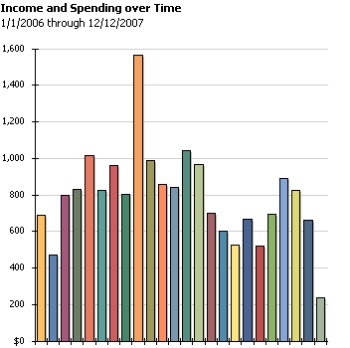
Tightening the Belt: Sometime during the first few months of 2007 I decided that I had to take control of the grocery budget. My goal was $600/month. During the year I tried several strategies to reduce the amount I’m spending on groceries, but I haven’t consistently applied all of them at the same time. Even so, I’ve spent less than $600 during four months, and the spending in the remaining months has decreased considerably. The chart below will give you an idea of how I’m doing. It starts in January of 2006 and goes through December 12th, 2007 (when I started writing this post…groan).
A New Year, A New Goal: My goal for 2008 is $400/month. I’ll be applying all 10 strategies that I used this year, but this year I’ll do them all simultaneously. If you’d like to give it a go too, here’s my list:
10 Strategies to Slash Your Grocery Bill
1. Plan your menus.The first step to smart grocery shopping is to plan what you are going to eat for the week. Check your calendar to see what events you have during the coming week and count how many breakfasts, lunches, and dinners you will need.
Now, take a sheet of paper and make a column for breakfast, lunch, dinner, and snacks. Brainstorm ideas for each meal. If you’re stumped, thumb through your cookbooks, check out your favorite gluten free blogs, or ask your family. Be sure to stick this list on your refrigerator so that you have a quick reference of what you’re planning to cook each day.
I’m going to do my best to post my weekly menu on the blog, and also submit it to the Gluten Free Menu Swap, so be sure to check back every Monday for our new menu.
2. Shop with a list.Shopping from a list is a building block strategy for reducing your grocery spending. The goal is to make a list of ingredients for the meals you’ve just planned, and then only buy the things on the list. I’ve tweaked this a bit and shop from a “pantry list” instead of a regular grocery list.
A pantry list is a pre-printed list of foods that you want to have on hand all the time. I use it as a checklist and go through my pantry and refrigerator every week to make sure I still have everything on the list. If I don’t have something, I mark down how many I want to buy. Once this is done, I add any additional ingredients that I need for the week’s menus, and I’m ready to shop. This strategy alone will keep you from buying item’s you don’t need because you can’t remember whether you have them or not.
3. Set a weekly budget.My budget for 2007 was $600/month. This amount was allocated out by week - $100 a week for Weeks 1 and 2, and $150 a week for Weeks 3 and 4. This was doable as long as I planned to buy dog food, diapers, and toiletries during the second half of the month. The real problem with sticking to the budget was that I was not good at judging how many $ worth of groceries I had put into my cart. I often got to the checkout counter and discovered (to my horror) that I had bought $200 worth of groceries instead of $150.
My solution to this problem was to bring a calculator and pencil along on the shopping trip. When something goes into the cart I write the price down on the back of my pantry list. At the end of every aisle I find a spot where I won’t be run over and tally up my total. By keeping a running list, I’m better able to determine whether I can buy things that aren’t necessities (like hot chocolate and marshmallows…mmm).
I’ve also started highlighting the items on my list that I don’t have to have and I put these groceries into the top part of the cart (where David would be if he were with me). If I get to the end of my shopping trip and realize that I need to put some things back, they are, at least, easy to find.
4. Track prices.When I find a pantry item at a good price, I like to stock up. However between blogging, work, and home I can’t keep up with all of the prices in my head. My pantry shopping list can though.
Here’s how it works. The first time that you shop with the list, jot down the price of each pantry item that you purchase in the price column. When you get home, type that price into the spreadsheet so that it will print out on next week’s list. Every time that you shop, check the prices again. When you find a lower price, just mark through the old one, write down the new price and update your list when you get home. Within a few weeks you’ll have figured out the rock-bottom prices at your grocery store and you’ll know a good price when you see one.
5. Monitor “in-between” trips.Trips to the store during the week are my budgeting downfall. I never save any money for these trips, so pretty much anything we have to buy between big shopping trips is outside of our budget. And we always buy more than we on into the store for.
The only solution that I see to this problem is to do a better job of planning meals and making my grocery list. This year I’ll be saving the receipts from my in-between shopping trips so that I can analyze what I’m buying. I think that I’ll find that I need to add some more items to the pantry shopping list. I probably also need to do a better job of anticipating how much snack food we’ll need. And there may be additional issues that I’m not aware of. Monitoring the receipts should give me some answers, and possible some new strategies for saving.
Feedback:As I shared earlier this week, I’ve got a lot to learn about grocery shopping. I’m convinced that I can get better and I’m sure that there are people out there in the blogosphere that can give me good advice. I’d love to hear your thoughts on my strategies; let me know in the comments whether you think these will work and what you do go lower your grocery budget. Also, if you’re not shy about sharing, how much do you spend on groceries each month?
Friday, January 16, 2009
Frugal Friday!
It's Frugal Friday!If you would like some frugal tips click on the icon above. It will take you to a website dedicated to Frugal Tips.
I do a lot of internet orders from websites. Some time ago I recommended http://retailmenot.com/ for a source of coupon codes where you might find discounts and special offers from the websites you order from. I have discovered that there are a number of sites similar to this where you can get discount and special off coupon codes. Here are a few I have found:
Friday, January 09, 2009
Frugal Friday
It's Frugal Friday!
Here is a TV clip on how to save money by organizing your mail. I wanted to embed the video here so you wouldn't have to go to the website, but their link for embeding the video seems to be broken...or at least that's the error message I kept getting when I tried to save it. So go to the website and watch the video. It's short and to the point. You'll have to endure some adverstisements since it is a TV news clip.
Ok, so it looks like when you go to the link, the video will not just start up for you...wait a minute and in the right hand column there will come up a list of videos for you to choose from. Choose "Ways to Save: Organize...". if it doesn't show, then type it in the video search box at the top of the video list. I hope this will work for you!
Friday, January 02, 2009
Frugal Friday
It's Frugal Friday!If you would like some frugal tips click on the icon above. It will take you to a website dedicated to Frugal Tips.
What better way to start the New Year then with a budget to help you save money and spend your money wisely? Go to http://www.budget5000.com/ and set up a budget. I use it and love it.
Friday, December 19, 2008
Frugal Friday
It's Frugal Friday!If you would like some frugal tips click on the icon above. It will take you to a website dedicated to Frugal Tips.
Here's a fun website full of frugal sense. Thriftyfun.com
Friday, December 12, 2008
Frugal Friday Tips
It's Frugal Friday!If you would like some frugal tips click on the icon above. It will take you to a website dedicated to Frugal Tips.
Do you have a Dollar Store near you? You might be surprised at some of the treasures you can find there! Recently, I picked up a music CD that came with a magazine for $1. It was 74 minutes worth of beautiful piano music by Chopin and the magazine was all about his life and music and a little history about the piano. I bought three of them so I could give a couple as gifts. What a great gift for only a buck!
When I had to travel with my husband last month, I was looking for ways to pass the time and found a dollar store there. I was pleasantly surprised to find gluten free cookies. Two dozen for a dollar! I bought a couple boxes, went out to the car and tried them. They were so yummy I went back in and nearly cleaned them out.
Also, at that same store I found 15 postal service note cards that were replicas of the love stamp they had for a while that had the two swans facing each other, making the heart shape. Once again, only a dollar. What bargain.
I love pugs and found some other note cards last week, 10 for a dollar that have a picture of a pug smoking a cigar and driving a taxi...it's really cute. They will make fun thank you notes for after Christmas for my family.
The sad thing with the dollar store, though, is you never know what they will have and chances are the item you bought last time won't be there again next time.
Friday, December 05, 2008
Frugal Friday: The Gift Closet
It's Frugal Friday!If you would like some frugal tips click on the icon above. It will take you to a website dedicated to Frugal Tips.
My Frugal Friday tip of the week regards the Gift Closet. Each year after Christmas we go to town and look for the after Christmas sales. Later we look for the inventory reduction sales before tax time and again late spring we find some places are having big spring cleaning sales. I take a list, usually in my head, but probably should take it on paper of who I need to buy gifts for in the coming year and start shopping for those at these sales. I bring all my treasures home and make a list of what I got and who I plan to give it to and put it all in my closet in a box.
When Christmas or birthday rolls around I go to my "Gift Closet" to see what I have there before I shop for anything. Many times I already have something that I purchased at a sale that was able to get dirt cheap.
This accomplishes two things:
- You aren't caught at the last minute with nothing to give and having to stress out about what to buy.
- You have been able to buy a nice item at a fraction of the original cost, saving your budget.
Subscribe to:
Posts (Atom)